What 2 Years of Coaching Beginners Has Taught Me About Learning Pickleball
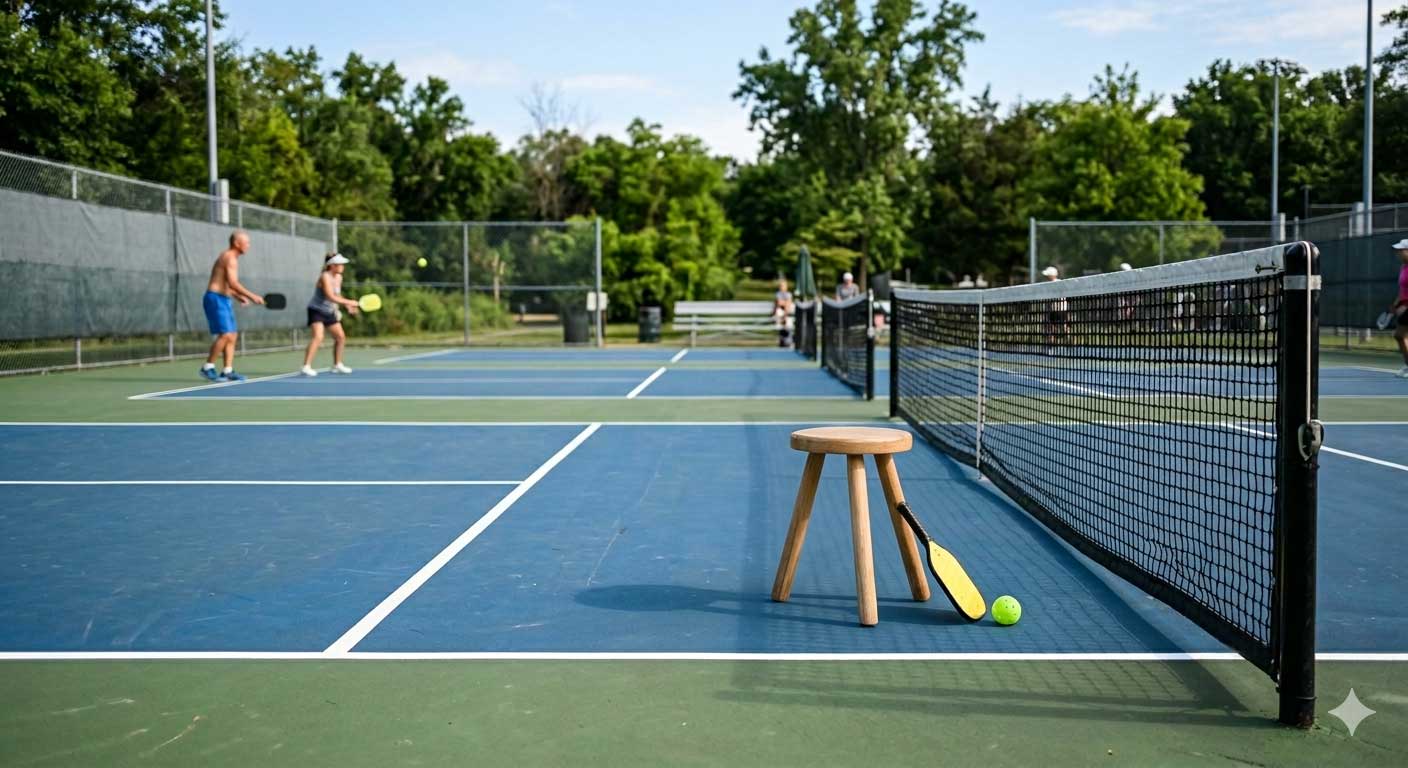
Just as a stool won’t stand without 3 sturdy legs, pickleball proficiency requires 3 key skills working in harmony.
I learned to play pickleball in Fall 2023 at free newbie lessons (led by volunteers) at my neighborhood park in Southern California. In early 2024, on the same courts, I became a competitive rec player by playing with the intermediate/advanced players in organized open play. With a background in badminton, racquetball, and ping-pong (and tennis in my DNA from my mother), I picked up pickleball quickly.
I thought about volunteering to coach in the same program someday, but I wanted to get more playing experience first.
In March 2024, the newbies program became short-staffed, with a single coach trying to cover 25 to 50 students. I wasn’t sure I was ready, but with opportunity knocking, I offered to help. A month later, two other former students joined me as volunteer coaches.
Since then, we’ve created and refined a 12-week drill cycle to introduce newbies to pickleball. Students new to the program attend two introductory lessons and then join the current drill cycle (which may already be in progress). We hold two-hour classes twice a week with three full-time coaches (including me) and three part-time coaches.
Our program has a simple mission: we teach players with little to no pickleball experience the rules, fundamental skills, and court etiquette they need to step onto any rec pickleball court and play credibly with good court manners and sportsmanship.
In my time as a coach, I’ve seen all the mistakes beginners typically make: getting stuck in transition, missing serves, hitting balls going out, violating the kitchen, and countless others.
In developing our curriculum, one pattern has become crystal clear. A student can have the best hand-eye coordination, fitness, and athletic aptitude in the world, but none of that matters if they don’t become proficient in three fundamental skill areas.
To emphasize this point to my students, I like to describe pickleball proficiency as a three-legged stool. If any of the three legs is deficient or missing, the stool will wobble or fall.
What are the three legs?
- Serve & return – you hit most of your serves in and can return most serves.
- Court position – you understand where to be on the court and when.
- Confidence at the net – you aren’t fearful of standing at the non-volley zone line and are ready for any shot that might come your way.
Serve & Return
Serving
In rec pickleball, you score points only when your team serves the ball and then wins the rally. If your opponents serve, you can win the rally but not the point. Hence, if you can’t get your serves in, you can’t score points.
A competent pickleball player should be able to land 9 out of 10 serves inbounds. I like to tell my students that “an in serve is better than a good serve.”
An in serve is better than a good serve.
What do I mean by that?
A deep, high-arcing lob serve that lands in 9 times out of 10 is much better than a fast drive or spin serve that goes into the net 40% of the time. You want a standard, baseline serve that is consistent (and ideally deep). Once you’ve mastered that, you can play around with “fancier” serves.
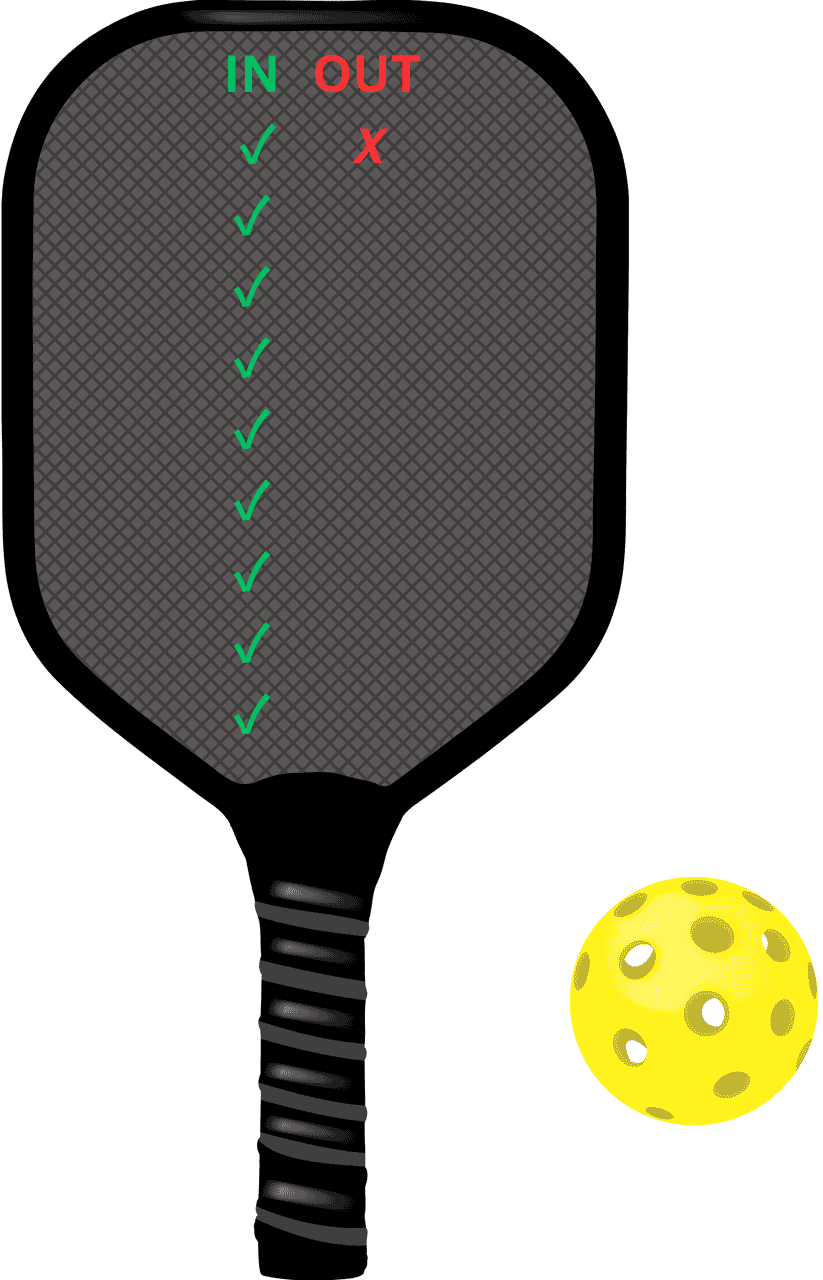
We emphasize serving when new students join our program. Toward the end of lesson #1, we introduce basic serving rules and practice serves. In lesson #2, we spend about half the time on basic serving drills. In our 10-week drill cycle, the first session is a serve clinic.
Are you getting the impression that serving is a critical skill area?
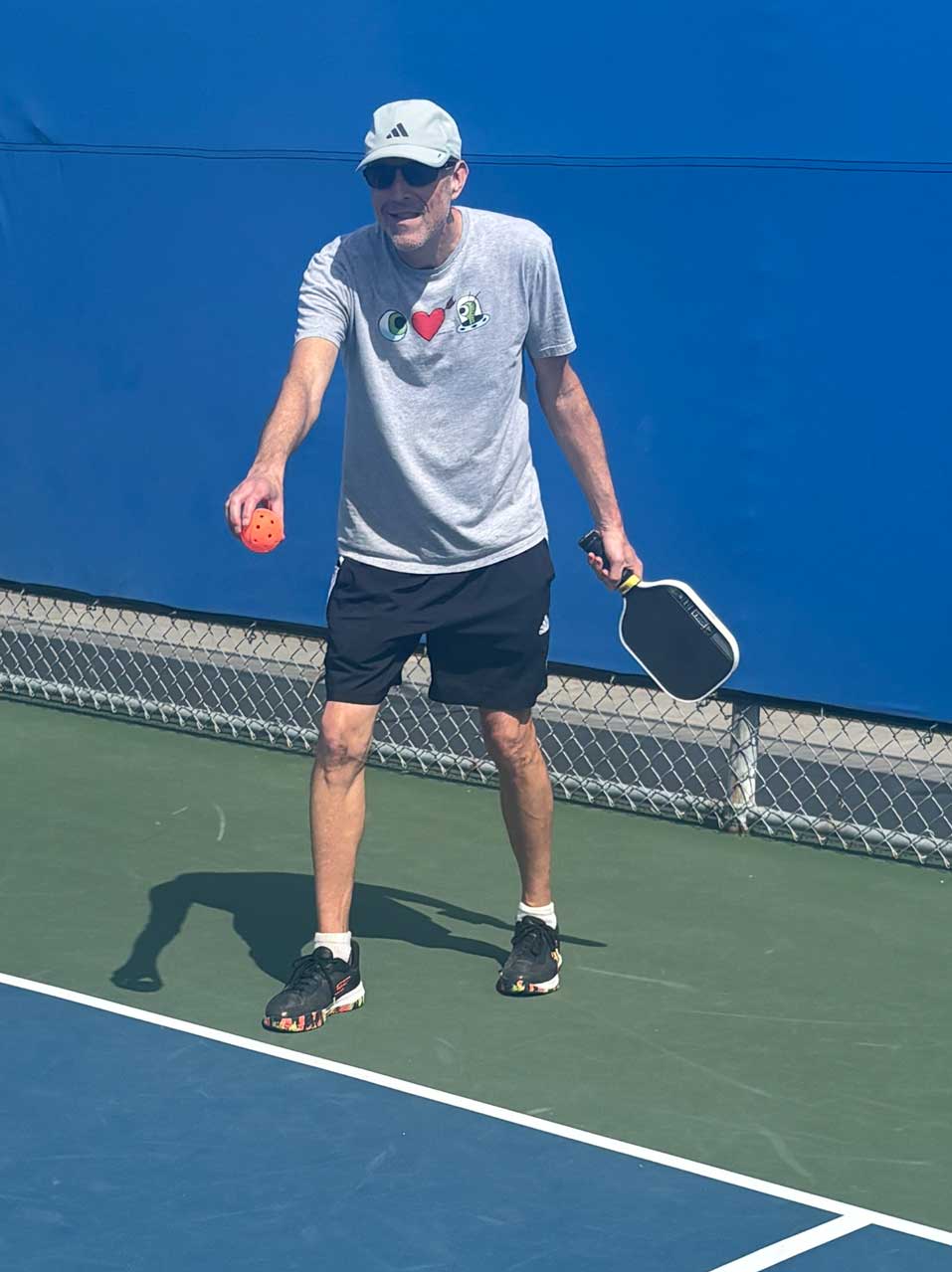
Every player has a preferred serving style: volley serve vs. bounce serve, facing forward vs squaring up, forehand vs. backhand (okay, that’s rare). As long as their serves are consistent and relatively deep, we don’t make adjustments.
However, if a student is hitting their serves out to the left or right, I coach them to:
- Face the receiver.
- Point their feet toward the middle of the receiver’s box.
- Swing their paddle straight ahead.
- Point their paddle on the swing’s follow-through right where they aimed their serve (like they’re shaking hands with the receiver).
Some beginners tend to point their feet out of bounds or rotate their torso as they hit, causing them to angle their serve to the side. My tips above remedy these problems.
If a student is struggling to get their serves deep, I ask them to try to hit a home run and serve it past the baseline (out of bounds). Most of the time their serve lands deeper but still well inside the court. In fact, I’d rather see a student serve too deep and rein it in than struggle to get the ball past mid-court.
I’d rather see a student serve too deep and rein it in than struggle to get the ball past mid-court.
After serve clinic, can you guess what session #2 of the drill cycle covers?
Returning
As with serving, the key principle with returning serves is consistency. You should be able to return most serves, whether your opponent serves short or deep, or targets your forehand or backhand.
If you can’t return serves, you can’t compete in rallies or earn a “side out” — where the serve comes back to your side of the court. If you can’t win back the serve, you can’t score points.
One challenge with students practicing serves and returns with each other is that they tend to face shorter and/or easier serves than they’d see in rec play against better players. For this reason, the last drill in this session is: Returning Coaches’ Serves. Coaches hit medium-to-difficult (and mostly deep) serves to students to give them a better feel for what they’ll eventually face. This drill is an eye-opener for many students.
Court Position
If you’re an experienced pickleball player who learned the game with good instruction, you can easily identify rec players who had no training or poor coaching — simply by looking at their court-position mistakes. They may do one or more of the following:
- They serve and rush onto the court.
- They hang back and neglect to move to the net after returning a serve.
- They park themselves in the transition area.
- They stand like a statue at the kitchen line.
These types of mistakes are deadly on a pickleball court if you’re playing against skilled opponents. In fact, if you see the opposing team making these mistakes, you should take advantage of them.
To remedy these errors (or prevent them in the first place), we coach our students to adopt the habits below:
Serve & Stay
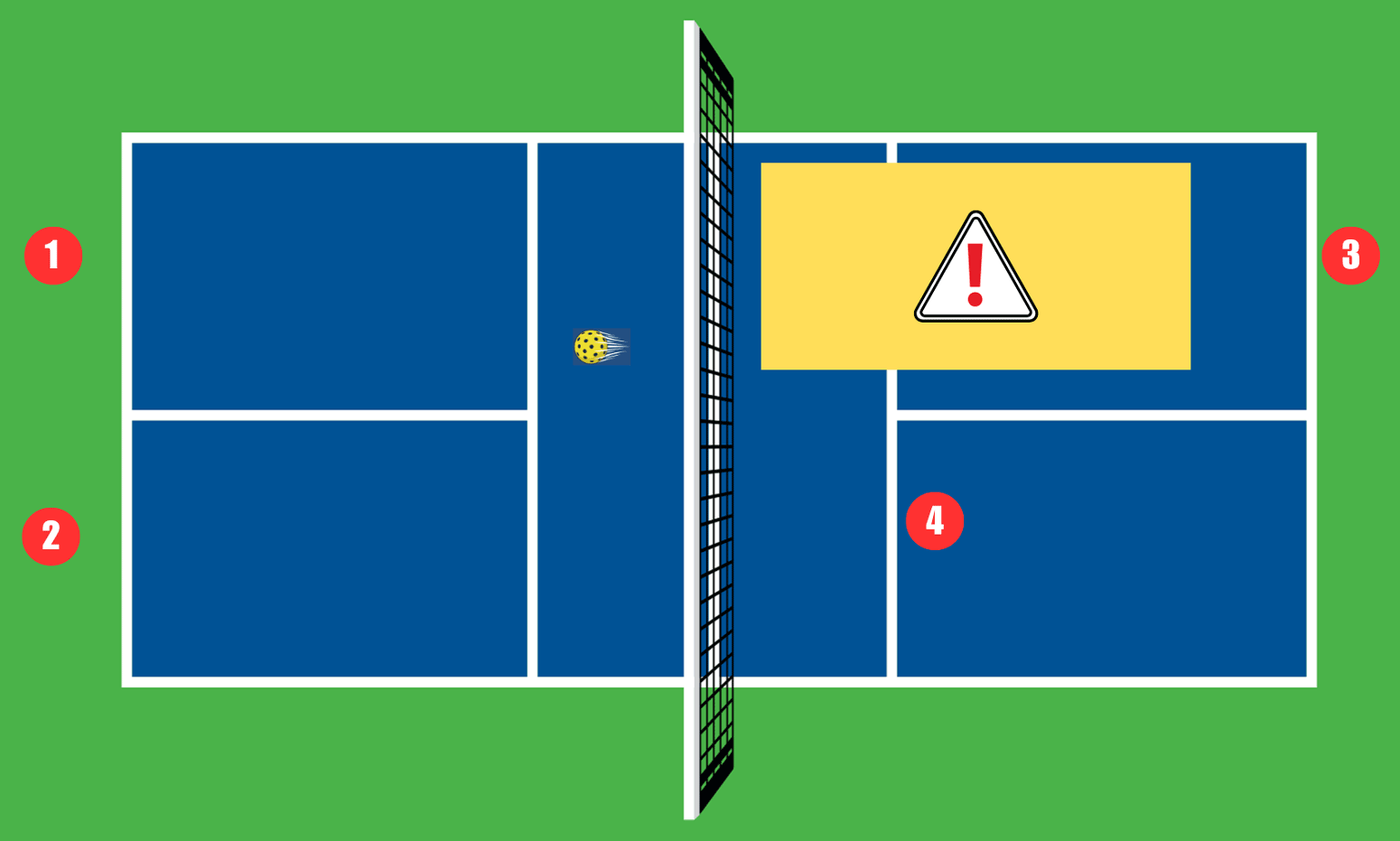
Novice players often take several steps into the court after serving or rush to the net prematurely. The gotcha with this tendency is that most good players return serves deep, which presents two problems.
- You may be tempted to hit the ball out of the air, which would violate the two-bounce rule.
- You may have to scramble backwards to return the ball. Athletic players can occasionally recover, but most will hit off-balance shots that go out, into the net, or set up their opponent. There is a truism in pickleball: it’s easier to run forward than backwards.
It’s easier to run forward than backwards.
The diagram below illustrates the peril of moving onto the court after your serve.
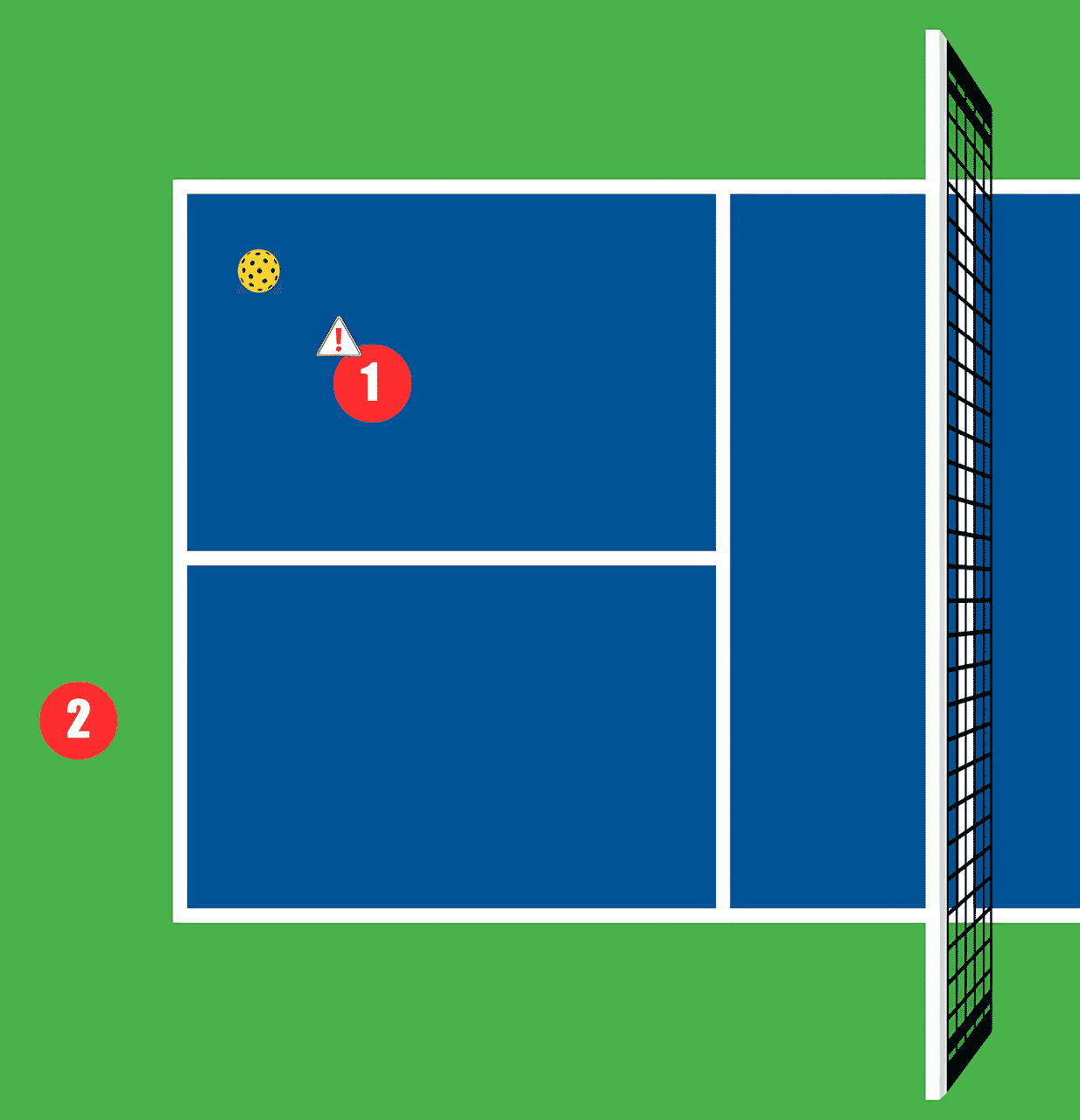
If you notice that one partner in a doubles team consistently creeps into the court after the serve, you should target your returns toward that player.
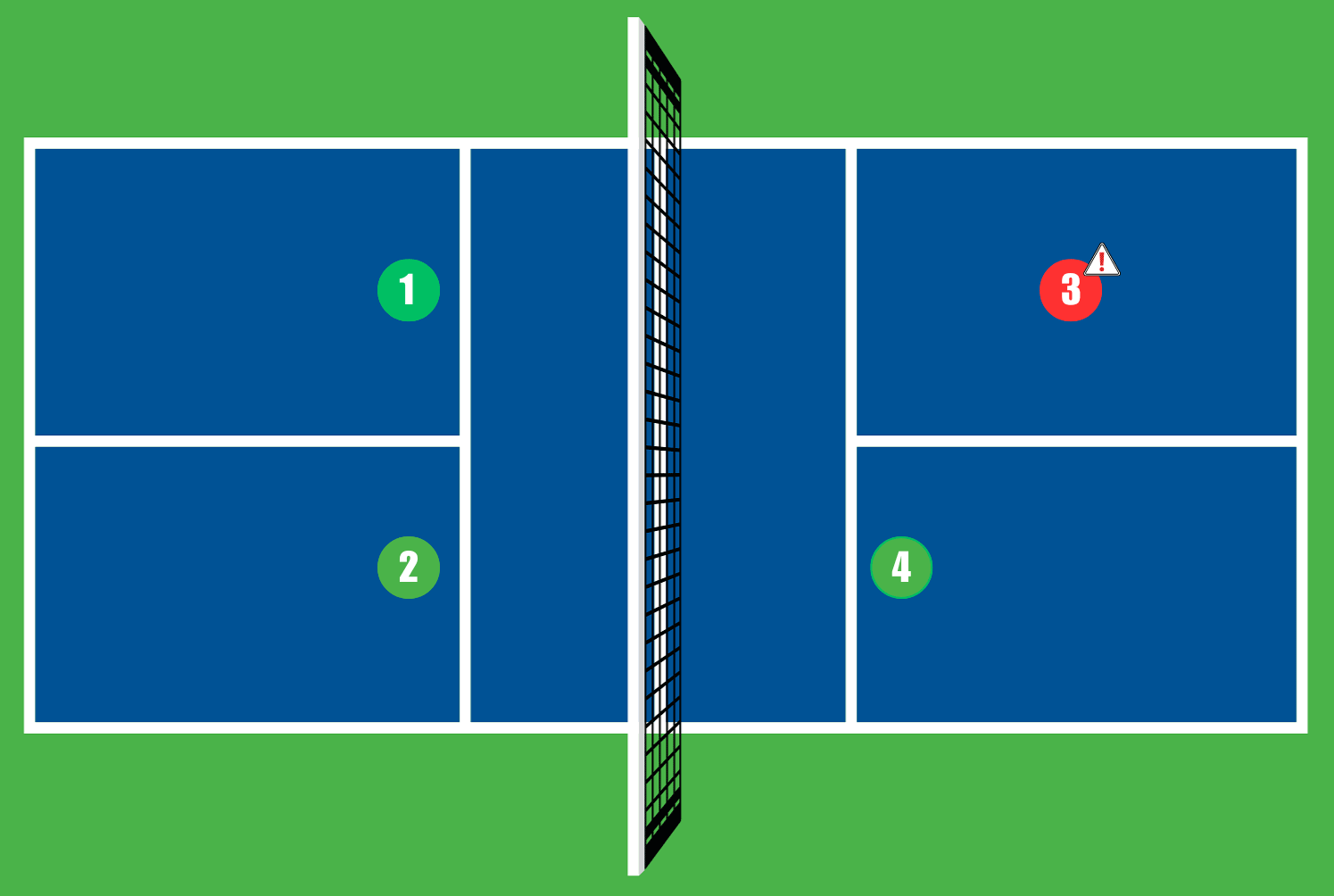
Return & Run
After returning a serve, a player’s goal is to join their partner at the kitchen line. We coach our students to return and run (or at least to return and move forward). If a player hangs back, then it opens up a big hole on the court that’s difficult to cover.
If one partner on a doubles team stays in the backcourt, you generally should keep hitting to that player and avoid the player near the net.
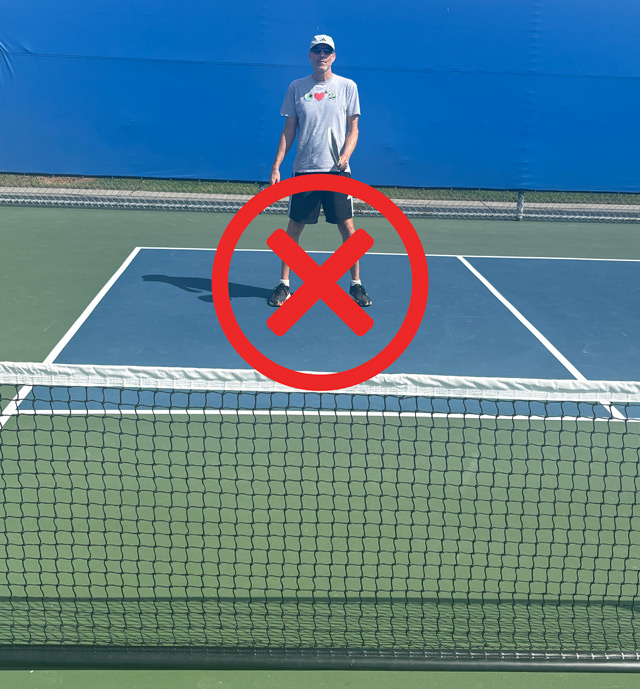
Stay Out of the Transition Area
If you watch professional doubles matches, you’ll notice that the overwhelming majority of the time, all four players are at the net. This tells you something. The non-volley zone line is where you want to be.
The non-volley zone line is where you want to be.
However, many beginners (and even some experienced players) stop at mid-court and play in the transition area.
Is that a bad thing? Various nicknames for the transition zone help answer the question:
- The messy middle.
- No man’s land.
- The zone of death.
- The losing zone. (I coined that one.)
- The loser lounge. (One of my students improved on my nickname.)
The middle of the court between the baseline and the kitchen line is called the transition because, as a player, you should be there only when transitioning from the back court to the net. (Some exceptions exist: e.g., after popping up, best practice is to shuffle backwards into the transition to try to return the likely smash.)
The middle is messy because you are vulnerable to so many different types of shots:
- Shallow dinks that land just over the net. Many players aren’t fast enough to rush up and return the dink.
- Drives at your feet. Hitting balls near your feet is one of the most awkward shots in pickleball.
- Drives that land behind you. You’ll miss them or have to run backwards (never a good idea, as I already explained).
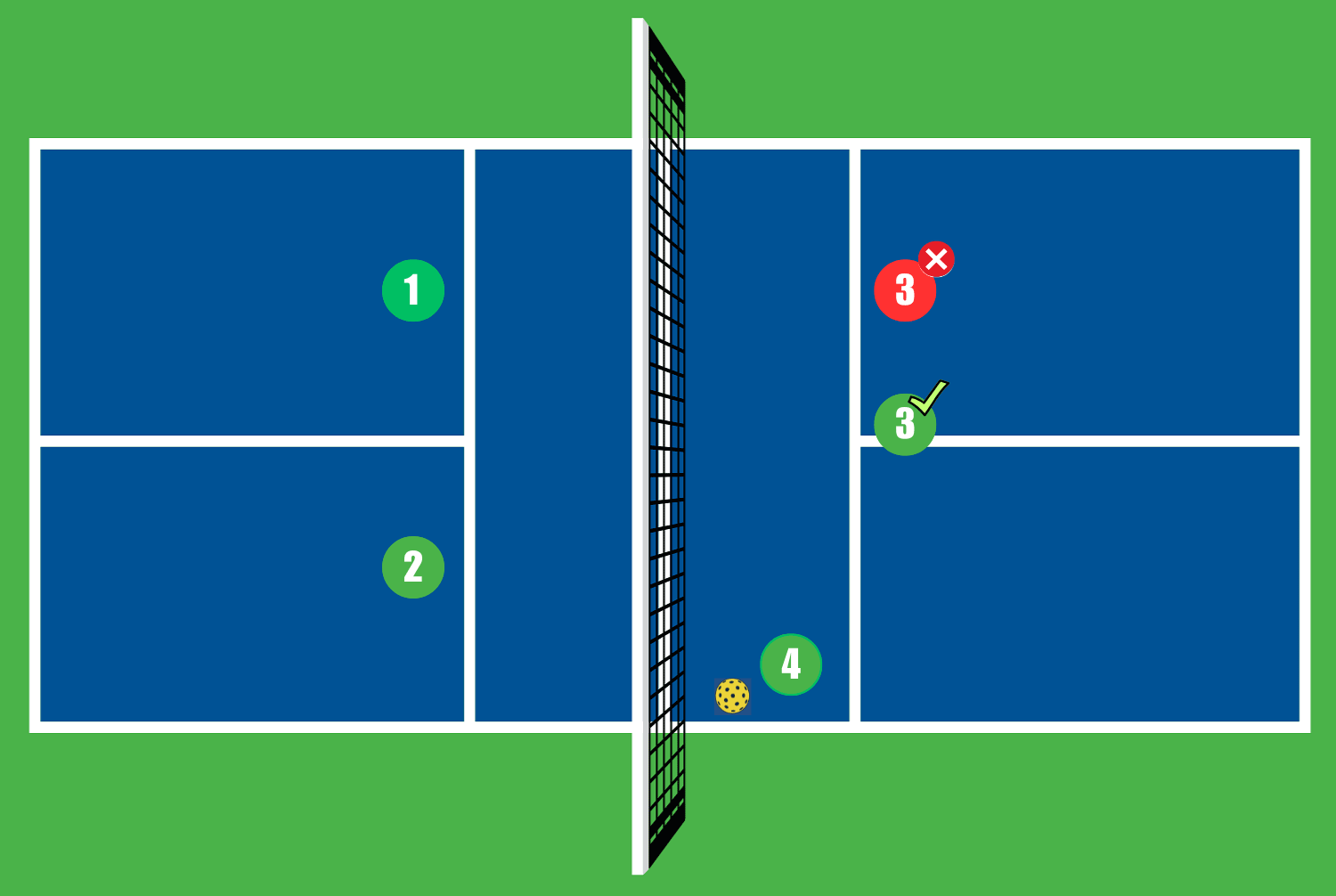
Move with Your Partner at the Kitchen Line
Some newbies think their job is done once they’ve reached the kitchen line. However, once you’re there, you need to be light on your feet and move around with your partner. The goal is to maintain a 6 to 8-foot distance from your partner to avoid creating court coverage gaps for your opponents.
For example, if your partner moves to the left side of the kitchen to return a dink, you should shuffle left to near the center line. Otherwise, you open a big gap in the middle. When your partner repositions to the center of their box, you should do the same.
For rec players trying to play in competitive games, developing even just one of these bad court position habits can be fatal, let alone two or more. This is why our third session is dedicated exclusively to court position, and we run drills to practice serving and staying, returning and running, and moving in coordination with your partner.
At every class, court position errors are a key area we look for and call out during the last 30 minutes when our students play practice games.
Confidence at the Net
One reason some students say they stay in the messy middle is that they’re afraid of standing close to the net (just behind the non-volley zone). Overcoming this fear and becoming comfortable at the net is the third stool leg every student must build to become a credible player.
In our newbies program, we use several methods to help students become more confident at the kitchen line.
Eye Protection
We preach the importance of eye protection during announcements at every class. Pickleballs can bounce quickly and randomly off your (or your partner’s) paddle and hit you in the eye before you can react. However, if you’re wearing glasses, sunglasses, or safety glasses, a pickleball can’t hurt you much. Your eyes are protected, and the ball can only do so much damage to your body. In the worst case, you’ll get a mild bruise or abrasion, but this sort of injury is rare.
Paddle Up
We coach our students to think of their paddles as shields. If you’re in a ready stance with your paddle up, you can quickly adjust your paddle to block a fast drive that’s about to bean you.
At a minimum, you can use your paddle to shield yourself from the ball. In fact, reflecting fastballs over the net is the first step to volleying. If the opponent has hit hard enough, the ball will bounce off your paddle with enough momentum to clear the net.
Skilled players will actually anticipate where the ball will arrive and punch it back, often at an angle or down the middle, depending on where they see a weakness in their opponents’ court positions. This turns a defensive block into an offensive shot.
We coach our students to keep their paddles up (usually around chin level), not only for self-defense, but also because pickleball is way too fast for anything but small paddle adjustments. If your paddle is down by your knees (e.g., after a dink), and the next shot is a fast drive at your chest, by the time you raise your paddle, you’ve either missed the ball or your paddle is at an awkward angle, and your return pops up or out. But if your paddle is already up and ready, you usually have enough time for a small adjustment to reflect or punch the drive back.
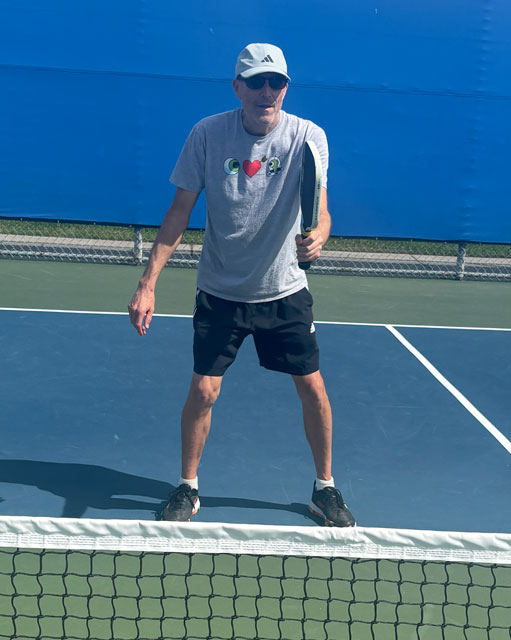
Don’t let pro pickleball matches fool you. Rec players need to hold their paddles higher than professional players, as the Pickleball Union explains in this helpful article: Most Rec Players Hold Their Paddle Too Low At The Kitchen.
Volleying Drills
The next step after protecting your eyes and keeping your paddle up is learning to volley effectively. (A volley is when you hit the ball out of the air before it bounces, which the rules permit as long as your feet are behind the kitchen line.)
In our fourth drill session, we run a set of scaffolding drills that incrementally build our students’ volleying skills, including:
- Practicing grip adjustment for backhand reflections. (Unlike other shots in pickleball, backhands are usually the most comfortable way to hit a volley return.)
- Practicing forehand and backhand volley shots against a backboard.
- Cooperative volleying with a partner.
- Practicing backhand reflections and punches.
- Returning coaches’ drives.
As with returning coaches’ serves, returning coaches’ drives can be intimidating for newbies. The ball comes fast, and they must learn to react quickly.
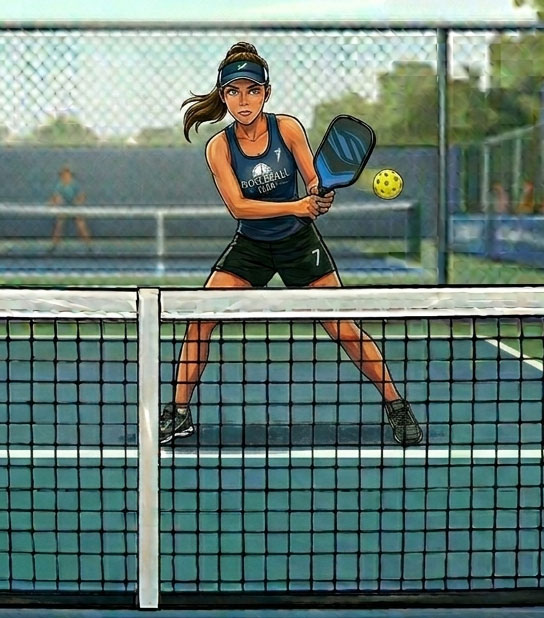
Hitting dinks well is also an important skill for playing confidently at the net, and we have an entire drill session dedicated to dinking. However, in rec play, beginners are more likely to see fastball drives (especially from former tennis players) than the soft game (dinks and drops). So, I think learning to volley effectively takes priority.
A Catch-All Drill
I like one drill above all others as a diagnostic tool to evaluate a student’s ability in the three core areas.
Serve, Return, Play Out the Rally
This drill is deceptively simple.
- One side serves.
- The other side returns.
- The students play out the rally.
It’s not a game, so there’s no scoring. The serve rotates around the court, so each player gets a chance to serve.
I like this drill because it quickly exposes bad habits and skill gaps.
- Do the students know where to line up before the serve?
- Does the server (and their partner) stay behind the line after the serve?
- Can the server land the ball in or deep?
- Can the receiver return the ball over the net?
- Does the receiver move toward the net after returning the ball?
- Do any of the students park themselves in the messy middle?
- Can the students hold their paddles correctly to reflect drives, smash pop-ups, and avoid unintentional angles that send the ball up or out?
For advanced beginners, I sometimes run a variation of the drill.
Serve Deep, Return Deep, Play Out the Rally
In this version, I stop the play if the serve or return isn’t deep. I tell my students to think of the drill like a diagrammed football play — everyone must execute their role correctly, or we start over. Sometimes, I also require a third-shot drop to try to get the students into a dink war, but that’s a story for another day.
Additional Skills
After we’ve taught the big three (serve/return, court position, net play), we cover other skill areas at subsequent drill sessions. A few examples:
- Dinking (as I mentioned above).
- Communication.
- Drops.
- Hitting and returning smashes.
- Common mistakes.
While these additional skills are important, my main goal for each student is to build the core skills into mindless habits.
My main goal for each student is to build the core skills into mindless habits.
If you’re still thinking about serve and stay, return and run, paddle up, etc., then it’s difficult to progress in pickleball. Once these things are on autopilot, you can become more present, better follow the flow of a game, and start focusing on strategy and shot selection.
Near the end of our drill cycle, we usually hold a competition day, where students compete in games like Powerball and Skinny Singles.
Finally, we conclude each drill cycle with an open play day. No drills. Just organized rec play with a paddle rack lineup similar to what students would experience on most local courts. The coaches observe from the sidelines to point out mistakes, and we also occasionally rotate into the games to provide a taste of what it’s like to play with tougher opponents.
After that, we start a new cycle and circle back to the serving clinic.
Final Thought
If you’re taking lessons and your instructor isn’t emphasizing serving and returning consistency, where to position yourself on the court, or how to play with confidence at the net, you might want to look for a different program.
Your Turn
Disagree with how I’ve prioritized core pickleball skills? Have other habits you think belong on the list? Let me know in the comments.
Note: Comments are moderated, so there may be a delay before your comment appears.
Nice job, Randy. Appreciate you, and all the volunteers in this program and your collective commitment (and paitience 😀) to helping us learn this great game!